“The whole is greater than the sum of its parts.” – Aristotle
It’s hard to believe that some 2,300-year-old Greek philosopher could have predicted the benefits of Shakeology, but ol’ Aristotle kinda nailed it.
Besides being flat-out delicious, one of the things that makes Shakeology so great is the synergy of its ingredients.
In other words, the various ingredients cooperate in ways that can help them work better together than if you consumed them separately.
Shakeology’s potent blend of ingredients — proteins, probiotics, fiber, digestive enzymes, adaptogens, antioxidants, superfoods, vitamins, and minerals — helps your body do what it was designed to do and perform at a higher level.
Plus, the brains behind Shakeology are constantly seeking to improve the formula with new ingredients that meet the ever-evolving nutritional demands of your body.
But instead of quoting old guys in togas and throwing down 11th-grade vocab words, the best way to illustrate this is to show you some examples of this synergy, so here we go.
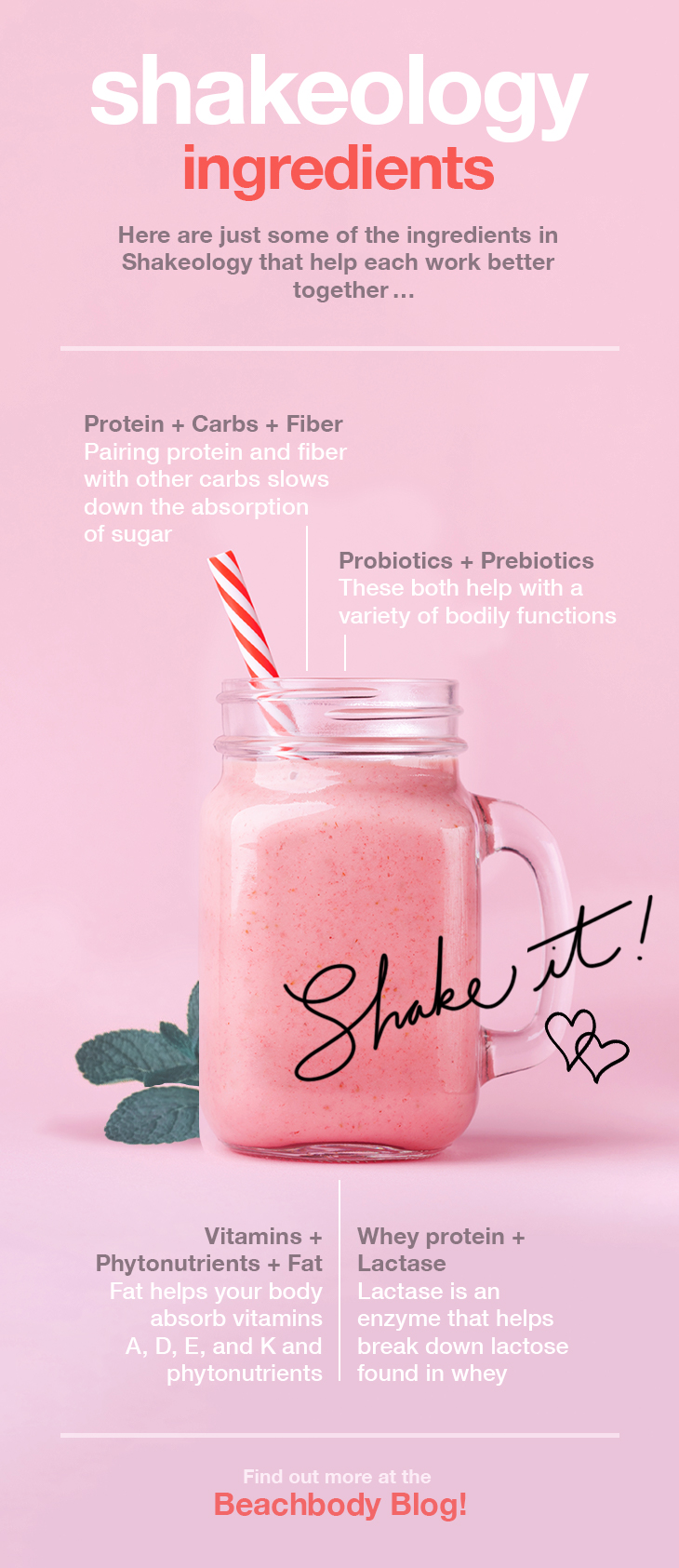
Protein, Carbs, and Fiber
This grouping is what makes Shakeology low glycemic. When you eat too many carbohydrates without anything to slow their absorption, it can cause a blood sugar spike.
Eventually, that sugar burns off, causing a sugar crash that your body addresses by signaling a craving for more carbs to fill the void.
Pairing protein and fiber with other carbohydrates slows down the absorption of sugar into your bloodstream. Because blood sugar doesn’t spike in the first place, you avoid the sugar crash and garbage cravings that can follow.
Probiotics and Prebiotics
Your digestive system is filled with bacteria — and that’s a good thing since these little guys aid an ever-emerging list of important bodily functions, including digestion.
However, there are both “good” and “bad” bacteria in there, which is why it’s important to consume probiotics (aka, “good” bacteria) as well as prebiotics (non-digestible fiber).
Shakeology contains both, so you can have your cake and eat it, too — only it’s really healthy “cake.”
Vitamins, Phytonutrients, and Fat
This may not sound like a match made in heaven, but vitamins A, D, E, and K and phytonutrients such as lutein (which you’ll find in kale and spinach) are all fat-soluble, meaning your body needs fat to better absorb them into your system.
Shakeology contains at least two grams of fat, depending on the flavor, and that helps you better absorb those fantastic nutrients.
Whey Protein and Lactase
Whey protein comes from dairy. It’s one of the most efficiently digested proteins around and you’ll find it in all non-vegan Shakeology flavors.
Unfortunately, some people may have challenges with the small amount of lactose you find in whey. To help solve this, we added lactase, the enzyme that breaks down lactose — and we didn’t just throw some in just to be fancy.
Phytonutrients
The science behind how these nutrients from plants function within the body is still emerging. Frankly, we simply don’t understand all their benefits.
Studies do seem to show they work best synergistically with the other components of the organisms they exist in. So instead of adding isolated nutrients, we generally include whole plant powders and extracts in Shakeology.
Iron and Vitamin C
Plants contain a kind of iron called “nonheme” iron which can be challenging for the body to absorb. Luckily, most flavors of Shakeology contain vitamin C, which greatly helps with nonheme iron absorption.
Calcium and Vitamin D
Your body needs calcium to support your bones, muscles, and heart. Your body needs vitamin D to absorb calcium. Shakeology contains both.
The Bottom Line
This isn’t an exhaustive list. We put a lot of thought into Shakeology’s ingredients and given their variety and the myriad benefits that come with them, the cases of ingredient synergy are almost endless!
from Nutrition – The Beachbody Blog https://ift.tt/2vZN1nx
Comments
Post a Comment